
As stated in Essential Recipes Worth a Thousand Gold: The ancient measuring standard defines eight ancient inches as one foot. For body-cun, take the first segment of the middle finger of the patient — left hand for males, right hand for females — as one cun.
If finger lengths vary, use the transverse width of the first thumb segment as one cun instead. Adjust flexibly according to actual conditions; proficiency lies with the practitioner. Arcane Essentials from the Imperial Library adopts the same method. Another record notes that the full length of a middle finger equals three cun.
According to Imperial Grace Formulary: Currently, one cun is measured as the distance between the two creases on the second segment of the middle finger (left for males, right for females). Clinical practice proves this method effective for treatment, so it is now the standard for acupoint measurement. Shi Cangyong also follows this rule.
Use waxed paper strips or thin bamboo slips to measure the distance between the two creases on the middle finger segment of the patient (left for males, right for females). This unit is called body-cun.
- When the finger is bent: Measure the distance between the two corner junctions on the lateral side of the middle finger segment.
- When the finger is extended: Measure straight from the lower crease of the upper finger segment to the second crease of the middle segment.
Both bent and extended postures yield the same cun length. Note that people differ in finger shape and fingerprint patterns, so practitioners need to measure carefully.
Cut paper or bamboo slips to a total length of six body-cun, mark clear divisions for each cun with ink, and keep the segments uniform in length. Store the measuring tools for locating moxibustion acupoints.
Gaohuangshu points are located three cun bilaterally below the 4th thoracic vertebra along the mid-spine, which are acupoints of the Bladder Meridian of Foot-Taiyang.
(Attached illustrations: Waxed Paper Gauge, Bamboo Slip Gauge, Pericardium Meridian Diagram, Lung Meridian Diagram, Cun Measurement with Bent Finger, Cun Measurement with Extended Finger)
量同身寸法
《千金方》云:尺寸之法,根据古者八寸为尺,仍取病者男左女右手中指上第一节为一寸。亦有长短不定者,即取手大拇指第一节横度为一寸,以意消息,巧拙在人。《外台方》亦同上法。又一云:三寸者,尽一中指也。《圣惠方》云:今取男左女右手中指第二节,内度两横纹相去为一寸。自根据此法,疗病多愈。今以此为定穴取寸,石藏用亦用《圣惠方》为准。以蜡纸条子或薄篾,量患人男左女右手中指中节横纹上下相去长短为一寸,谓之同身寸(若曲指节旁取指侧中节上下两交角相去远近为一寸。若伸指即正取中指自上节下横纹至中节中,从上第二条横纹长者相去远近为一寸。当曲指一寸长短,亦相符合。然人之身手指,或有异者。至于指纹亦各不同,更在此意详度之也。)此折纸篾与同身寸相等为六寸,逐寸以墨界之,勿令长短,有所出入不同,截断收之,俟以此量灸穴。自脊中第四下停,分两旁各三寸为膏肓,足太阳膀胱经脉气之所发也。
Wax paper sample (schematic restored from ancient texts)
Material: Waxed paper strip or thin bamboo strip, waterproof and not easily deformable.
Length: The distance between the two transverse creases of the middle phalanx of the patient’s middle finger is taken as 1 *cun* (proportional body inch), and the total length is cut to 6 *cun*.
Graduations: Clear ink lines are drawn every 1 *cun*, ensuring equal divisions without any variation in length.
Usage: When locating points such as BL43 (Gaohuang), use this ruler to measure 3 *cun* lateral to the spine.
Source: The *Method for Measuring the Proportional Body Cun* from *Moxibustion on the Gaohuang Acupoint (Jiu Gaohuang Shuxue Fa)*, compiled by Zhuang Chuo of the Song Dynasty.
Bamboo Slip Gauge
This thin bamboo slip is a traditional measuring tool for body-cun. Made of flexible and sturdy bamboo, it resists distortion.
- Standard: One body-cun equals the distance between two creases on the middle finger (left for males, right for females).
- Total length: 6 body-cun, marked with clear ink lines for each unit.
- Application: Locate acupoints for acupuncture and moxibustion, especially Gaohuangshu (BL43) which is 3 cun lateral to the spinal midline.
Pericardium Meridian (PC)
Originates in the chest, connects with the pericardium, descends through the diaphragm, and links the upper, middle, and lower triple energizers.
Key points: Tianchi (PC1), Quze (PC3), Neiguan (PC6), Laogong (PC8), Zhongchong (PC9).
Indications: chest pain, palpitations, mental disorders, arm spasms, palm heat.
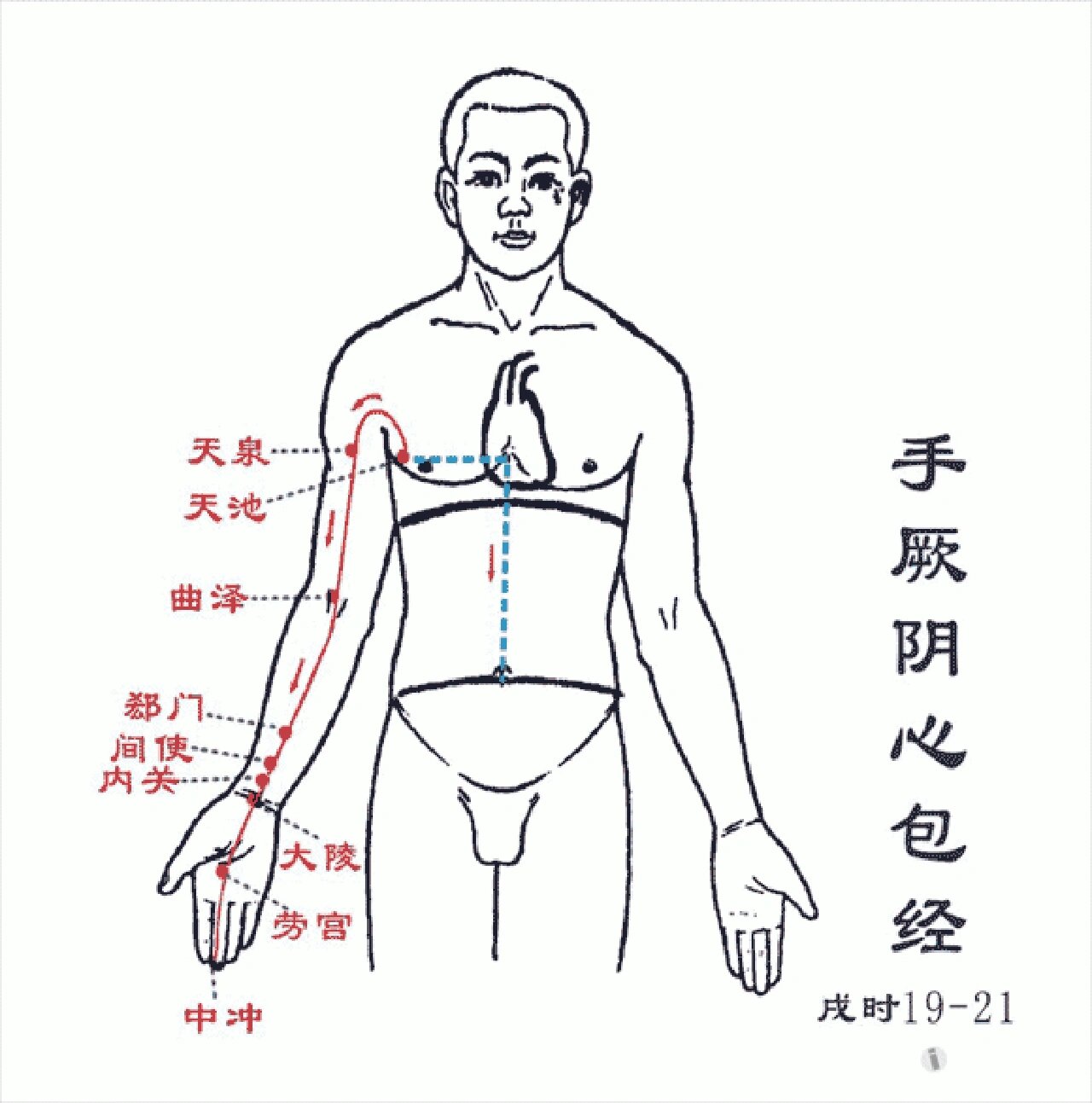
Lung Meridian of Hand-Taiyin (LU)
The Lung Meridian of Hand-Taiyin originates from the middle energizer. It descends to connect with the large intestine, curves back along the stomach, passes through the diaphragm and enters the lung.
Running from the lung, it exits laterally beneath the axilla, travels along the anterior border of the medial upper arm, descends to the elbow and the radial side of the forearm, passes the wrist, then runs along the thenar eminence and terminates at the tip of the thumb.
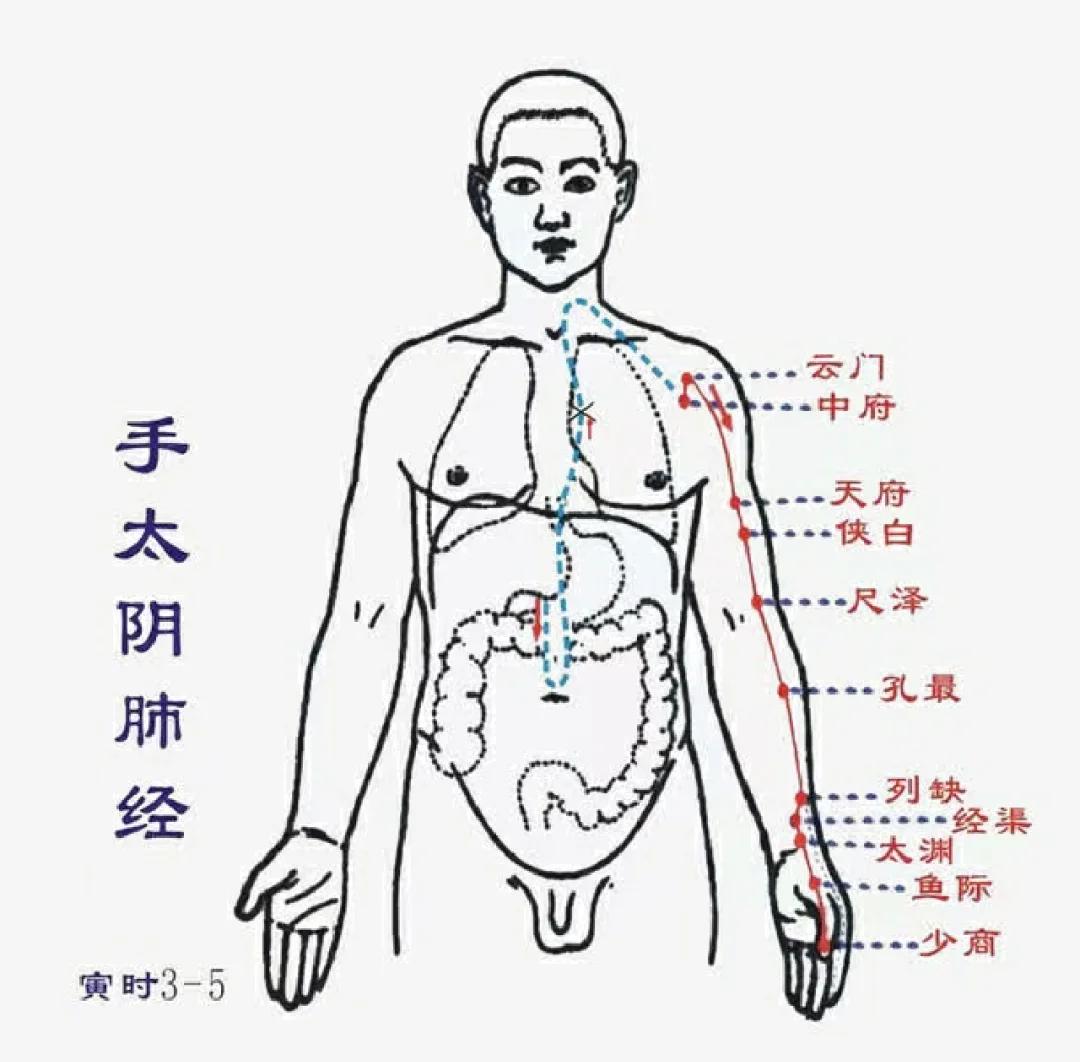
Its branch separates at the wrist and extends to the medial side of the index finger, ending at its tip.
Main indications: cough, asthma, chest distress, sore throat, hemoptysis, pain along the medial shoulder and arm, common cold and fever.
Cun Measurement Method with Bent Finger
When the finger is bent, measure the distance between the two corner junctions on the lateral side of the middle finger segment. This length is defined as one body-cun, the standard unit for locating moxibustion acupoints.
Rule: Left hand for male patients, right hand for female patients.
Posture: Bend the middle finger naturally.
Measurement: Take the distance between two lateral corners of the middle finger segment as 1 body-cun.
Usage: Make measuring gauges and locate acupoints such as Gaohuangshu.
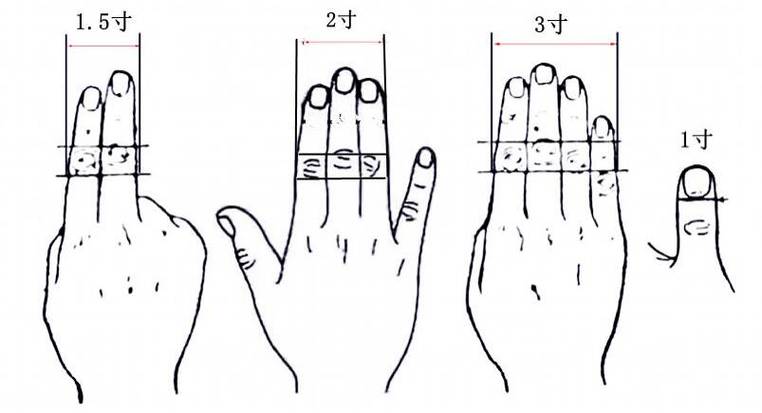
Ancient standard for body-cun. Measure between lateral corners of bent middle finger for accurate acupoint location.
Cun Measurement Method with Extended Finger
When the middle finger is fully extended, measure the distance from the lower crease of the upper segment to the second crease of the middle segment. The length measured with a bent finger and an extended finger is identical, both serve as the standard of one body-cun.
Rule: Use the left middle finger for males and the right for females.
Posture: Fully extend the finger without bending or straining joints.
Measuring spot: Between the lower crease of upper segment and the second crease of middle segment.
Function: Calibrate body-cun, make measuring tools and locate moxibustion points.
This method shares the same standard with the bent-finger measurement, widely used for acupoint location in ancient times.
What Is Body-Cun in TCM? Historical and Practical Foundations
In traditional Chinese medicine (TCM), the term body-cun refers to a proportional unit of measurement used to map anatomical distances on an individual patient. Unlike standardized units such as centimeters, body-cun is inherently person-specific, derived from the patient’s own body to ensure precise and individualized treatment. The historical foundations of this concept are rooted in classical texts like the Essential Recipes Worth a Thousand Gold, which state that eight ancient inches equal one foot but then define a body-cun through practical anatomical references. Thus, understanding what is body-cun in TCM requires recognizing it not as a fixed metric but as a dynamic tool for clinical accuracy. The body-cun measurement method traditional Chinese medicine employs is both empirical and adaptive, relying on patient-specific landmarks to guide needle insertion. This approach reflects the TCM principle of tailoring therapy to the individual’s unique constitution, emphasizing flexibility over rigid rules. Ancient physicians underscored that proficiency lies with the practitioner, meaning mastery of this method depends on experience and careful observation. By grasping the definition and historical significance of what is body-cun in TCM, clinicians lay the groundwork for effective and safe acupuncture practice.
How to Measure Body-Cun Finger Segment: Practical Techniques
The body-cun measurement method traditional Chinese medicine provides clear, actionable techniques for how to measure body-cun finger segment on a patient. According to classical sources, the primary method involves taking the first segment of the middle finger—specifically the distance between the distal interphalangeal joint and the fingertip—as one cun. For male patients, the left hand is used; for female patients, the right hand. However, the ancient text Arcane Essentials from the… acknowledges that finger lengths can vary between individuals, so an alternative approach uses the transverse width of the first thumb segment as
Interesting! I’ve always been curious about how ancient doctors measured precisely without rulers. The left-hand/right-hand distinction for body-cun is a neat detail. Do modern acupuncturists still use this method, or has it been standardized?
مقال رائع! طريقة القياس بـ”البوصة الجسدية” مفيدة جدًا في الطب التقليدي. لكن هل تختلف دقة القياس حسب حجم الأصابع بين الأشخاص؟ شكرًا على الشرح الواضح.
Interesting—I’ve always wondered how traditional medicine standardized measurements. Using the middle finger segment makes sense for tailoring treatments to each person. Would this vary much between individuals, or is it surprisingly consistent?