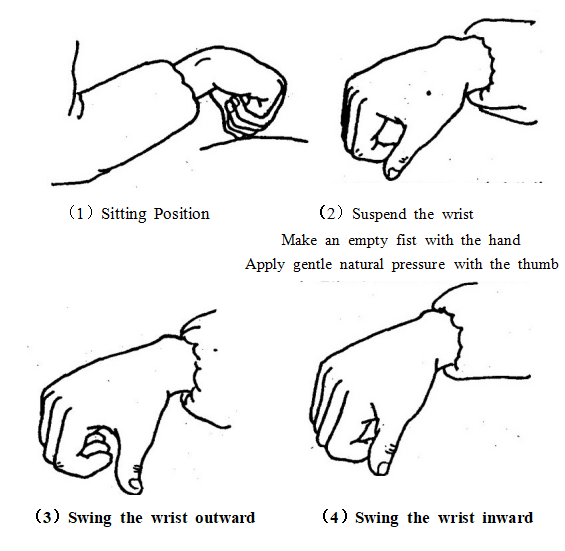
One-Finger Meditation Pushing (Yizhichan)
1. Definition
Apply the tip, the palmar surface of the thumb pad, or the radial side of the thumb (i.e., the thenar edge) onto the meridian, acupoint, or region. Keep the shoulder, elbow, and upper limb muscles relaxed. Through continuous wrist swinging combined with flexion and extension of the thumb joint, generate a sustained force that acts on the meridian, acupoint, or area.
2. Key Points
(1) Alternating between heavy and light force, continuously applied to the treatment area.
(2) The movements should be flexible and natural, with even and gentle pressure, a consistent rhythm, and a frequency of approximately 120–160 times per minute.
3. Location
Applicable to all parts of the body.
4. Actions
Relax the sinews and invigorate the blood; reduce inflammation and alleviate pain; relieve fatigue; and resolve accumulations and guide stagnation.
2. Kneading (Rou)
1. Definition
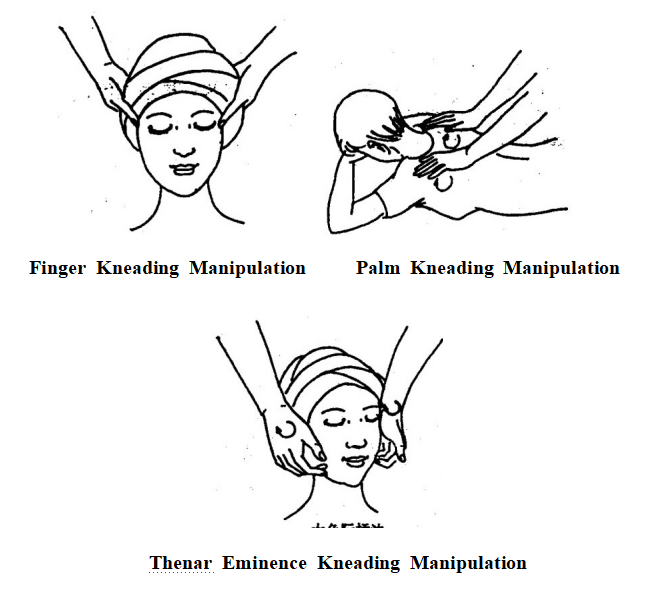
Kneading (Rou): A technique in which the practitioner uses the finger pads, the heel of the palm, or the thenar eminence to gently adhere to a specific treatment area or acupoint, and then performs slow, gentle, and even circular motions, driving the underlying subcutaneous tissue to be kneaded together.
2. Types
Finger Kneading (Zhirou)
The palmar surface of the thumb is pressed closely against the skin to perform circular kneading. The force should be applied gradually from light to heavy, and then from heavy back to light.
Palm Kneading (Zhang Rou)
Using the thenar eminence or the whole palm closely adhering to the skin, perform a circular kneading motion (Rou) in either a clockwise or counterclockwise direction.
Thenar Eminence Kneading (大鱼际揉法)
A method of applying force with the thenar eminence on the treated area and performing rotating kneading (Roufa).
3. Key Points
(1) During the operation, the relative position between the skin of the operator’s treatment area and the skin of the patient’s treatment area remains unchanged.
(2) Movements should be gentle and rhythmic.
(3) Frequency is approximately 70–180 times per minute.
4. Regions: Suitable for the head and face, neck, trunk, limbs, and other areas.
5. **Actions**: Relax sinews and activate collaterals, invigorate blood and dispel stasis, widen the chest and regulate qi, reduce swelling and alleviate pain.
3. Pressing (An)
1. Definition
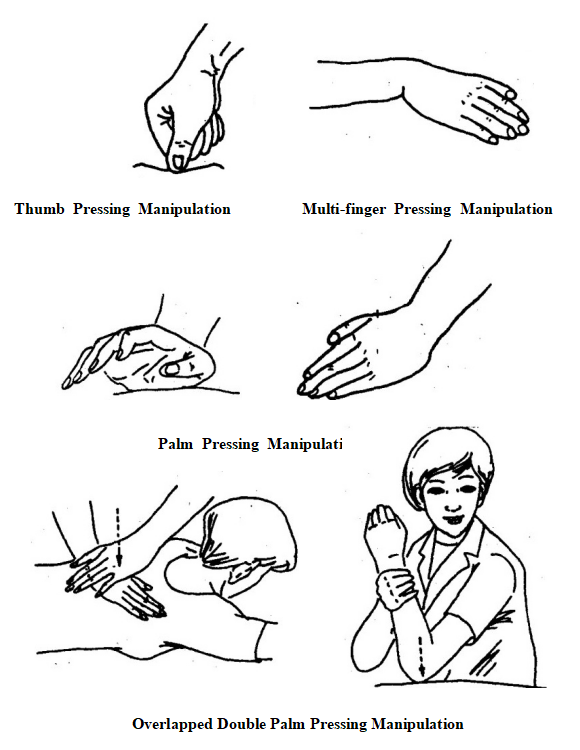
Using the thumb pad, thumb tip, palm root, interphalangeal joint, or elbow tip to press on a specific area or acupoint, gradually applying deep pressure and holding it in place, is called the Pressing technique (Anfa).
2. Types
Thumb Pressing (Muzhi An)
A method of applying pressure to the treatment area using the tip or pad of the thumb. (This is the pressing technique, *An*).
Multi-finger Pressing (Duozhi An)
Using the index, middle, ring, and little fingers, or any three of them, to apply pressing or overlapping pressing on a specific area of the patient’s body surface.
Palm Pressing (Zhang’an)
The method of pressing a specific area of the patient’s body surface with the heel of the palm (掌根), thenar eminence (鱼际), or the entire palm (全掌). Palm pressing (掌按) can be used—
Perform the technique with a single palm, both palms, or overlapping palms.
(4) Single-Palm Pressing (Dan Zhang An Fa)
A method that uses the heel of the palm to apply pressure to the patient’s body surface.
Double-Overlapping Palm Pressing (Shuangzhang Die’an)
The method of pressing with both palms overlapped on the recipient’s body surface.
Elbow Pressing (Zhou’an)
A method of pressing the patient’s body surface with the olecranon process while the elbow joint is flexed.
3. Key Points
(1) The force should be applied steadily without shifting.
(2) The force should be applied gradually from light to heavy; never press down violently or abruptly.
(3) When applying Pressing (An) to the chest and abdomen, the force should follow the rise and fall of the patient’s breathing.
4. Location
Suitable for the head and face, neck, lower back and spine, chest and abdomen, and the four limbs.
5. Actions
Unblock the meridians and activate collaterals, activate blood and relieve pain, relax muscles, and calm the mind.
4.Grasping (Na)
1. Definition
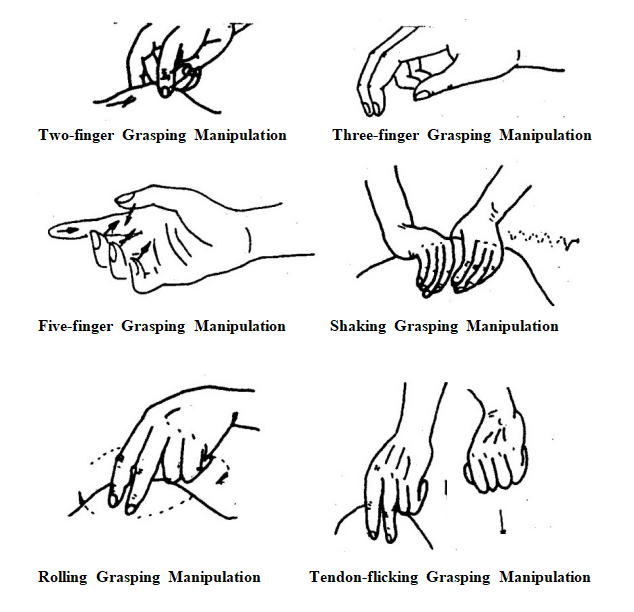
Using the thumb and index-middle fingers symmetrically, or the thumb and the other four fingers symmetrically, to apply force and lift-grasp a specific area, performing alternating tight and loose pinching-grasping.
2. Types
(1) Two-Finger Grasping (Erzhi Na)
**Pinching (Nie Fa):** Using one or both hands, the thumb and index finger oppose each other to apply relative force at the treatment site, performing continuous, rhythmic pinching and lifting motions.
(2) Three-Finger Grasping (Sanzhi Na)
Using one or both hands, with the thumb opposing the index and middle fingers, apply continuous, rhythmic lifting and pinching on the treated area.
(3) Five-Finger Grasping (Wuzhi Na)
A method in which the thumb of one or both hands works in opposition to the other four fingers to firmly grip the treatment area, and then continuous, rhythmic lifting and grasping motions are performed.
(4) Shaking Grasping (Doudong Na Fa)
Use the fingers to grasp and lift the muscle, gently shake it, then gradually relax the fingers, and repeat the operation.
Palm Grasping (Zhang Na)
Using the palm of the hand to closely adhere to the area being treated, perform slow grasping and kneading movements (Na-Rou).
(6) Rolling-Grasping method (Zhan Na Fa)
Using one or both hands to grasp the treatment area, with fingers applying opposing force, and performing a continuous, rhythmic twisting motion.
(7) Tendon-Plucking and Grasping (Tanjin Nafa)
The practitioner uses two or three fingers to grasp the skin or tendon, pulls it outward as far as possible, and then suddenly releases it with a sliding motion, causing a snapping sound from the skin or tendon during the slip.
3. Key Points
During operation, apply force using the palm surface of the fingers. The technique should be steady and gentle, with moderate intensity.
4. Location
Applicable to the neck, shoulders and back, lower back and abdomen, and extremities.
5. Action
Expel Wind and Dispel Cold, unblock the meridians, calm the mind and relieve pain, eliminate muscle fatigue, and relieve spasms.
This is fascinating! I’ve heard of acupressure before but never knew there was a specific technique like One-Finger Meditation Pushing. Does the wrist swinging motion really help relax the upper body? I’d love to try it for tension headaches. Can’t wait to read the rest of the list!
一指禅推法って美容にも使えるんですね!指先一本で経絡やツボを刺激するなんて、肩こりにも効きそう。もっと詳しいやり方や他のテクニックも知りたいです。続きが楽しみ!
Interesting! I’ve heard of acupressure but never this “One-Finger Meditation Pushing” technique. Does it really help with specific beauty concerns, like fine lines or puffiness? The wrist motion sounds tricky to master. Would love to see a video demonstration!
Sounds interesting! I’ve never heard of the One-Finger Meditation technique before. Is it mainly for facial relaxation or does it help with acne too? Would love to try it if it really works!