
1. The Needles and How to Use Them
(1) The Needles: The needles may be of gold,silver or alloy. The needles in most common use today are made of high quality stainless steel.On the basis of structure, the filiform needle may be divided into four parts the handle,the root,the body and the tip(Fig.1).
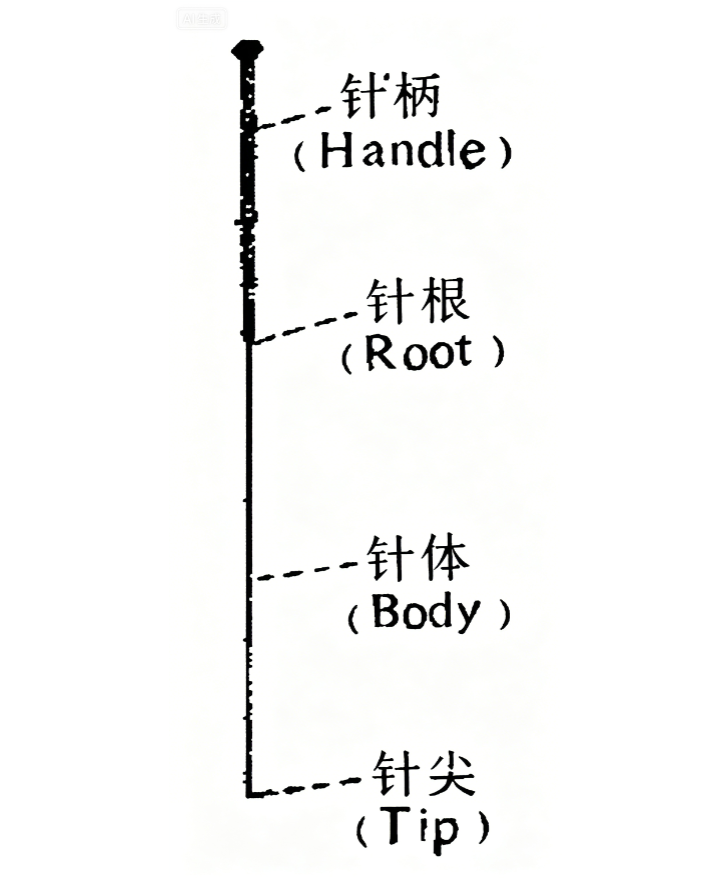
Fig.1 The Needles
The size and length of the needles most commonly used are as follows (Tab.1,2).
Tab.1
| Inch | 0.5 | 1.0 | 1.5 | 2.0 | 2.5 | 3.0 | 4.0 | 5.0 |
| mm. | 12.7 | 25.4 | 38.1 | 50.8 | 63.5 | 76.2 | 101.6 | 127 |
Tab.2
| Gauge | 26 | 28 | 30 | 32 |
| Diameter(mm.) | 0.46 | 0.38 | 0.32 | 0.27 |
(2) How to practise needling: The,filiform needle is very fine and flexible,and so it demands precise finger force to insert into the skin skillfully and manipulates it freely.In order to minimize possible pain to the pa-tient,it is advisable tostart practising with a shorter and thicker needle, progressing to a finer and longer one.
① Practise with sheets of paper. Fold fine soft tissue into a small packet about 5x8cm.in size and 1 cm.thick. Try puncturing it.Hold the paper packet in the left hand and the handle of the needle with the thumb,index and middle fingers of the right hand. Rotate
the needle in and out. As your fiuger force grows stronger, the thickness of the packet may be increased (Fig.2).
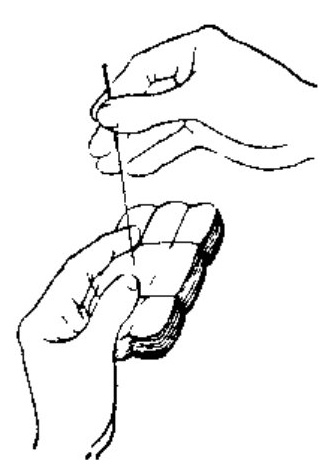
Fig.2 How to practise needling
② Practise with a small cotton cushion of about 5~6 cm,in diameter wrapped in gauze.Hold the cushion with the left hand and the needle with the thunb,index and middlc fingers of the right hand. Insert the needle into it and practise the lift-thrust and rotation proce-dure (Fig.3).
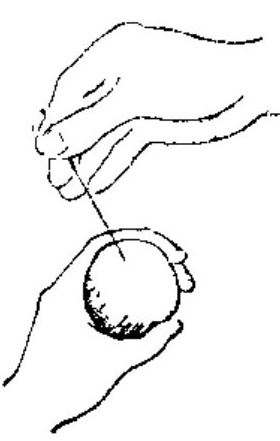
Fig.3
③ Practise on your own body:This may follow the manipulaion methods on paper packet and cotton cushion, so as to have personal experience of the acu-puncture sensation in clinical practice.
2. Insertion and Withdrawal of the Needle
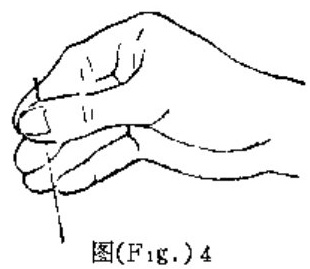
(1) Insertion: Generally,the needle is held with the right nand,known clinically as the puncturing hand,with the thumb and inder fingers holding the handle of the nee-dle and the middle finger backing the index finger near the needle root. The left hand, known as the pressing hand,presses upon the area close to the point. The co-ordination of the two hands is conducive to a swift penetration of the needle tip into the skin,which reduces pain on insertion (Fig.4).
According to the length of the needle and the location of the point,there are various methods of inser-tion.The four main techniques are as follows:
① Inserting the needle aided by the pressure of the finger of the pressing hand:Press beside the acupunc-ture point with the nail of the thumb or the index finger of the pressing hand, then insert the needle into the point against the nail. This method is suitable for puncturing with short needles such as those used for puncturing Neiguan,Kunfun etc.(Fig.5).
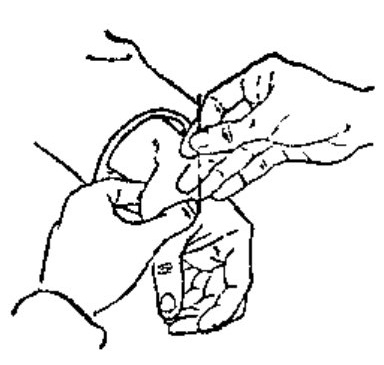
Finger-Pressing Insertion
② Inserting the needle with the hetp of the punc-turing and pressing hands. Hold the tip of the needle wrapped in a cotton ball with the thumb and index fingers of the pressing hand; fix it directly over the selected point; mneanwhile hold the handle of the needle with the puncturing hand, As the pressing hand pushes the needle tip into the skin, the puncturing hand presses it downward to the required depth. This method is suitable for puncturing with long needles,such as those used in puncturing Huantiao, Zhibian etc.(Fig.6).
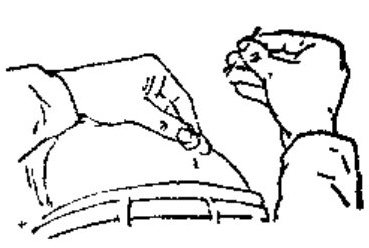
Parallel Finger Insertion
③ Inserting the needle with the fingers stretching the skin:Stretch the skin where the point is located to cause tension with the thumb and the index finger of the pressing hand to facilitate the insertion of the needle.This method is indicated for points where the skin is loose such as Tianshu, Guanyuan, ctc, on the abdomen (Fig.7).
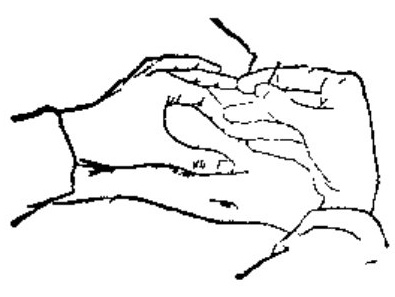
Skin-Stretching Insertion
④ Inserting the needle by pinching up the skin.Pinch up the skin at the point with the thumb and index finger of the pressing hand, insert the needle into the skin sidewise with the right hand.This method is suitable for puncturing points of the head and face where the soft tissue is thin, such as Zanzhu, Yintang, etc.(Fig.8).
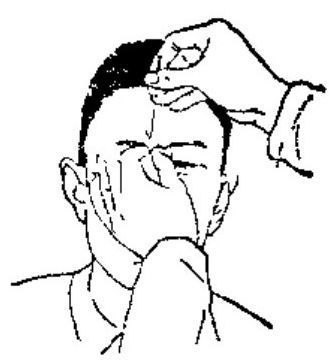
Pinch-Grasp Insertion
(2) The angle formed by the needle and the skin surface: The degree of the angles formed by the needle and the skin surface in puncturing depends upon the location of the point and the therapeutic purpose,There are three angles as following:
① Perpendicular, in which the needle is inserted perpendicularly forming a 90° angle with the skin sur-face.Most points on the body can be punctured perpen-dicularly.
② Oblique,in which the needle is inserted obli-quely to form an angle of approximately 45°with the skin surface. This method is indicated for points located where the muscle is thin or close to important viscera,such as Lieque of the forearm,Jiuwei of the abdominal area, Qimen of the chest,points on the back,etc.
③ Transverse, also known as horizontal puncture when the needle enters the skin forming an angle of from 15°~25° with its surface.This method is chosen for points onthe face and head where the muscle is thin,such as Baihui and Touwei of the head, Yangbai and Dicang of the face,Shanzhong of the chest,etc.
(3) Depth of needle insertion:It depends upon the thickness of the tissue where the point is located, path-ological condition, and the strength of sensation the patient experiences.As a rule,points on the extremities,abdomen and lumbosacral region may be punctured deep.
(4)Withdrawal of the needle. To prevent the bleeding at the site of puncture and the after-sensation,it is necessary to rotate the needle back and forth gen-tly before withdrawing it, then press the puncture site gently with a sterilized cotton ball upon withdrawal.
3. Precautions
(1) For patients who are famished, over-eaten, intoxicated, excessively fatigued, or in a state of severe debility, acupuncture treatment should be administered with fewer needles or delayed until their condition stabilizes.
(2) Acupuncture points located on the lower abdomen and lumbosacral region are contraindicated in pregnant women within the first three months of pregnancy. After three months of gestation, needling the upper abdomen, as well as points known to produce strong stimulation (including Hegu [LI 4], Sanyinjiao [SP 6], Kunlun [BL 60], and Zhiyin [BL 67]), is also contraindicated. Additionally, the fontanelle region of infants must not be needled.
4. Management of Possible Accidents in Acupuncture
(1) Acupuncture Syncope
Syncope during acupuncture commonly occurs in patients with physical debility, severe nervous tension, first-time acupuncture recipients, or following excessive needle manipulation. Early prodromal symptoms include dizziness, vertigo, restlessness, nausea, facial pallor, staring eyes, and lethargy. Severe cases may present with shock, unconsciousness, and deepened pulse.
Immediate management includes prompt needle removal and placing the patient in a supine resting position. Mild symptoms usually resolve after short rest or warm fluid intake. For severe cases, apply digital compression to Renzhong (GV 26), or perform needling at Renzhong (GV 26) and Zhongchong (PC 9). Moxibustion at Baihui (GV 20) and Zusanli (ST 36) is also applicable. Most patients recover rapidly; if symptoms persist, additional emergency medical interventions are required.
(2) Stuck Needle
A stuck needle refers to a condition where the inserted needle cannot be freely rotated, lifted, or thrust due to multiple clinical factors.
When caused by local muscle spasm, retain the needle briefly to relieve muscular tension, then perform gentle rotation for smooth withdrawal. Alternative methods include pressing the soft tissue surrounding the needle or needling adjacent acupoints to relax muscle spasms.
If the needle is entangled with fibrous tissue, rotate the needle slowly and gently to untangle surrounding fibers. Apply minimal lifting and thrusting until the muscle fully relaxes, then withdraw the needle steadily.
(3) Bent Needle
Needle bending is mainly caused by uneven finger force during insertion, forced needling, collision with hard tissue, accidental impact on the needle handle, or sudden body movement by the patient during needle retention.
For slight bending, withdraw the needle slowly without rotation. For obvious bending, follow the natural curved trajectory of the needle for gradual removal. If patient position change leads to bending, restore the patient to the original posture first, then extract the needle along the bending direction.
(4) Broken Needle
Needle breakage may result from vigorous manipulation, severe muscle spasm, abrupt patient movement, inferior needle quality, or corrosion at the needle base.
The practitioner must remain calm and instruct the patient to maintain a static posture. If the broken needle segment protrudes above the skin surface, remove it with sterile forceps. If the fragment is completely embedded subcutaneously, surgical extraction is necessary.
For prevention, practitioners must strictly inspect needle quality before use. The selected needle length must exceed the required insertion depth to avoid subcutaneous breakage.
(5) Hematoma
A tiny pinpoint red spot after needle withdrawal is a normal reaction and will fade spontaneously without intervention. Vascular injury may cause local bruising and swelling. For symptomatic hematoma, gentle local massage and hot compresses are recommended to accelerate blood stasis absorption and relieve swelling.
(6) Post-Needling Discomfort
Excessive acupuncture stimulation may cause persistent local distension, soreness, or discomfort after treatment. Mild residual sensations can be relieved by gentle local massage. For prolonged or severe post-needling discomfort, local moxibustion is effective for alleviating residual stimulation symptoms.