
Accurate acupoint location relies on three complementary methods from traditional Chinese medicine. Anatomical landmark positioning uses visible body features for rapid, tool-free point finding. Proportional bone measurement applies standardized body segments scaled to the individual. Finger cun measurement uses the patient’s own finger dimensions—1 cun from the flexed middle finger crease and 3 cun from four fingers’ width—for convenient on-site use.
Professional practice typically combines these methods to eliminate positioning errors and enhance treatment effectiveness. This integrated approach adapts to each patient’s anatomy, ensures consistency across body types, and supports both trunk and limb point localization. Diagrams illustrate the finger cun rules and their alignment with anatomical landmarks and proportional divisions.
Accurate acupoint location is the foundation of safe and effective acupuncture treatment. In traditional Chinese medicine (TCM), there are three mainstream, evidence-based techniques for precise acupuncture point positioning: anatomical landmark positioning, proportional bone measurement, and finger cun measurement.
Anatomical Landmark Positioning is the most intuitive and commonly used basic method for finding acupuncture points. It relies on visible and palpable body surface landmarks, including bony prominences and depressions, joints, tendons, muscle borders, skin creases, hairlines, nail edges, nipples, umbilicus, and facial features. Any acupoint located on or near these fixed anatomical markers can be positioned quickly and accurately without extra measurement tools.
Proportional Bone Measurement Method (standard body cun system) is a standardized TCM positioning technique. It divides different body segments into fixed proportional cun units. This universal body scaling rule applies to all individuals, regardless of age, height, weight or body shape, delivering consistent and precise references for locating acupoints far from obvious anatomical landmarks.
Finger Cun Measurement Method uses the patient’s own finger size as a personalized measuring scale, which is simple and convenient for clinical use. The standard rules are universally recognized: the distance between the two interphalangeal creases of a flexed middle finger equals 1 cun; the combined width of four closed fingers at the middle finger’s proximal joint crease equals 3 cun.
Professional acupoint positioning usually combines these three complementary methods. This comprehensive approach eliminates positioning errors, ensures precise point selection, and maximizes the therapeutic effect of acupuncture and moxibustion treatments.
Method Comparison & Reference Diagram Guide
The table below summarizes the core definition, operational features, and clinical application scenarios of the three acupoint location methods, matching the standard clinical diagrams (Figure 14 & 15) for intuitive reference.
| Location Method | Core Principle | Clinical Features | Applicable Scenarios |
|---|---|---|---|
| Anatomical Landmark Positioning | Locates acupoints based on visible and palpable fixed body surface structures, including bones, joints, tendons, skin creases and facial features | No measurement tools required, fast and accurate, high stability | Acupoints distributed on obvious anatomical markers, such as joint gaps, bony prominences and body midlines |
| Proportional Bone Measurement Method | Divides human body segments into fixed proportional cun units, adopting personalized body proportion scaling | Not affected by height, weight and body shape, unified and standardized positioning standard | Acupoints located in flat body areas without obvious landmarks, widely used for trunk and limb distant acupoints |
| Finger Cun Measurement Method | Takes the patient’s finger size as the measuring standard, including middle-finger cun and four-finger cun | Simple, portable and highly practical for on-site clinical operation | Auxiliary positioning for limb acupoints, convenient for emergency and out-of-clinic acupuncture operation |
Diagram Interpretation (Figure 14 & 15)
Figure 14 demonstrates the standard finger cun measurement: the flexed middle finger cun (1 cun) marked by interphalangeal joint creases, and the four-finger combined width (3 cun) at the proximal interphalangeal joint level of the middle finger.
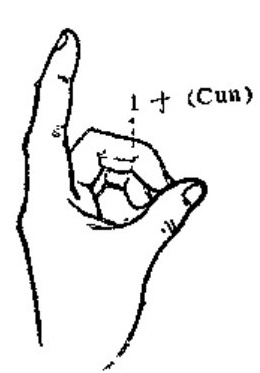
Figure 15 displays the overall matching relationship between anatomical landmarks, body proportional cun division and finger measurement scales, helping practitioners quickly calibrate acupoint positions and avoid positioning deviations.
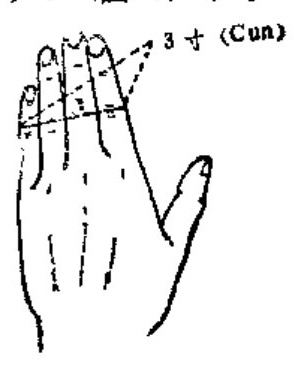
- Finger Cun Measurement Method: Uses the patient’s own finger size as a measuring scale, with 1 Cun defined by the interphalangeal creases of a flexed middle finger and 3 Cun by the width of four fingers, allowing convenient on-site localization.
Acupoint Location Using the Patient’s Fingers
The finger cun method provides practical and patient-centered approach to locating acupuncture points. By using the patient’s own finger size as a measurement standard, clinicians can fast, on-site point with minimal tools### Principle
finger cun method relies on body measurements derived the’s fingers. The most widely recognized rules:
- The distance between interphalangeal creases of a flexed finger equals 1 cun- combined width of closed fingers at the proximal joint crease equals 3 cun.
These references empower practitioners to convert complex anatomical data into precise, individualized measurements that are directly applicable to each unique patient. By utilizing established guidelines and benchmarks, clinicians can translate detailed structural observations into quantifiable metrics, such as bone dimensions, joint angles, or soft tissue thickness, that reflect the specific characteristics of a person’s body. This translation process is essential for tailoring interventions—whether in surgery, rehabilitation, or orthopedics—ensuring that decisions are grounded in both anatomical knowledge and patient-specific needs. For example, a surgeon might use these references to calculate safe implant sizes, while a physiotherapist could adjust range-of-motion targets based on individualized joint measurements. Ultimately, this approach bridges the gap between generalized anatomical models and real-world clinical practice, enhancing precision, safety, and outcomes for each individual.
Practical Application
- Prepare patient and ensure comfortable position to allow access to the target region.
- Identify reference hand: select the patient’s dominant hand or the hand closest the point of interest.
- Establish the 1 cun unit: locate the interangeal creases on the flexed middle finger andate the 1 cun along the body from a defined starting landmark.
- Establish the 3 cun unit: align the four-finger width the interphalange crease to create 3 cun span for points situated at broader distances.
- Translate the target point into: map the ideal point location using combinations of 1 cun and 3 cun segments as needed.
- Verify symmetry and consistency: compare bilateral points when indicated and point placement with each successive measurement to deviation.
Advantages
- Personalization: measurements adapt to the patient’s unique anatomy.
- Convenience: requires only the patient’s hands, making it ideal for bedside or outreach settings.
- Quick reference: straightforward rules facilitate rapid point localization procedures### Considerations and Tips
- Practice enhances accuracy: repeated use improves spatial intuition and reduces measurement errors.
- Combine with other methods: for complex points, supplement finger cun measurements anatomical or proportional bone references.
- Consider variations: factors such as hand, finger architecture and edema can influence measurements; adjust as needed.
- Maintain hygiene and comfort: ensure patient’s hand position remains relaxed to distortion landmarks.
Quick Reference Guide
- 1 cun: distance the interphalal creases of the flexed finger.
- 3: combined of four closed fingers at proximal crease.
Safety and Professionalism
Always point locations through clinical judgment and, when appropriate, corroborate with locating techniques.itize patient safety comfort, and clear communication the procedure.