
Accurate localization of acupuncture points is essential to achieve optimal therapeutic outcomes. Three standard methods are commonly used for precise point location, as described below.
1. Anatomical Landmark Method
Visible and palpable surface landmarks including bony prominences and depressions, joints, tendons, muscles, skin creases, hairlines, nail margins, nipples, umbilicus, eyes and mouth serve as reliable references for point location. Acupoints situated on or near these landmarks can be identified directly.
2. Proportional Measurement Method
Based on anatomical landmarks, the proportional measurement method is adopted to locate acupoints that lie away from obvious reference markers. In this approach, the length or width of different body regions is divided into equal standard units called cun, which serve as the fundamental measuring unit for acupoint localization.
(1) Head
Longitudinal measurement
The linear distance from the anterior hairline to the posterior hairline equals 12 cun.
If the anterior hairline is unclear, measure from the glabella and add 3 cun.
If the posterior hairline is also indistinct, measure from Dazhui and add another 3 cun.
The total distance from the glabella to Dazhui is 18 cun.
Transverse measurement
The distance between the two mastoid processes is 9 cun. The same measurement applies to the distance between bilateral Touwei points.
(2) Chest and Abdomen
Longitudinal measurement
Chest measurements refer to intercostal spaces. The distance from the lateral axillary fold to the tip of the 11th rib is 12 cun.
For the upper abdomen: the distance from the sternocostal angle to the umbilicus center is 8 cun.
For the lower abdomen: the distance from the umbilicus center to the superior border of the pubic symphysis is 5 cun.
Transverse measurement
The distance between the two nipples, or between the bilateral midclavicular lines, is 8 cun.
(3) Back
Longitudinal measurement
Measurements are referenced to the spinous processes of the vertebrae.
Transverse measurement
The distance from the medial border of the scapula to the posterior midline of the body is 3 cun.
(4) Upper Extremities
- Upper arm: The distance from the axillary fold to the cubital crease is 9 cun.
- Forearm: The distance from the cubital crease to the wrist crease is 12 cun.
(5) Lower Extremities
- Medial thigh: The distance from the level of the superior pubic symphysis to the medial epicondyle of the femur is 18 cun.
- Lateral thigh: The distance from the apex of the greater trochanter to the midpoint of the patella is 19 cun.
- Medial lower leg: The distance from the inferior border of the medial tibial condyle to the tip of the medial malleolus is 13 cun.
- Lateral lower leg: The distance from the center of the patella to the tip of the lateral malleolus is 16 cun (See Figure 13).
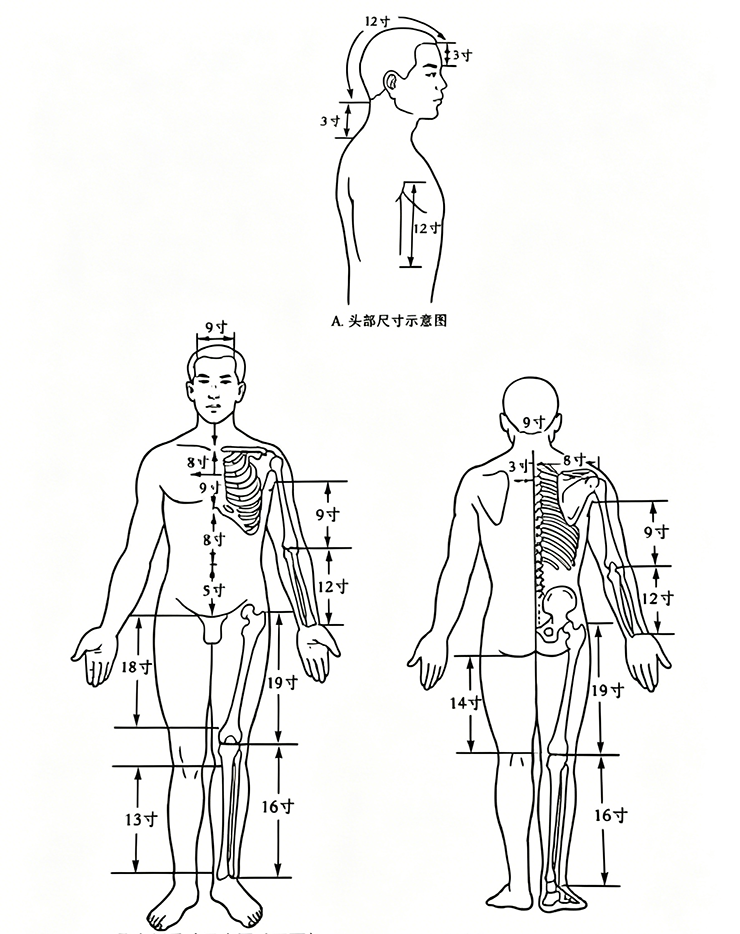
Figure 13
3. Finger Measurement Method
This method uses the patient’s own finger(s) as a reference scale to locate acupoints. The most commonly used techniques are as follows:
Middle Finger Cun: When the patient’s middle finger is flexed, the distance between the two ends of the interphalangeal joint creases is defined as 1 cun.
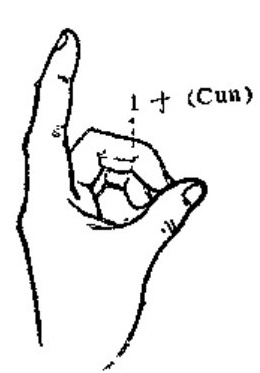
Measuring with the middle finger
Four-Finger Cun: The combined width of four fingers (index, middle, ring, and little fingers) held together at the level of the dorsal proximal interphalangeal joint crease of the middle finger is defined as 3 cun (See Figures 14, 15).
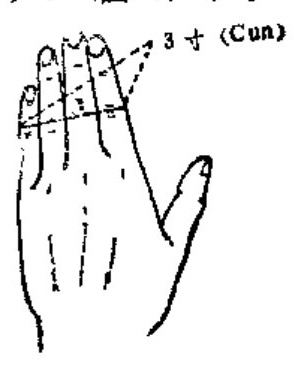
Measuring with the four fingers
1.Head & Face
| Measurement Area | Landmarks | Cun Value | Clinical Use | Notes |
|---|---|---|---|---|
| Longitudinal Head | Anterior hairline → Posterior hairline | 12 cun | Acupoint location on the top of the head | If hairlines are indistinct, calculate from glabella to posterior hairline (15 cun) or Dazhui to anterior hairline (15 cun) |
| Longitudinal Head (Alternative) | Glabella → Anterior hairline | 3 cun | Supplementary measurement when the anterior hairline is unclear | Glabella refers to the area of Yintang (EX-HN 3) |
| Longitudinal Head (Alternative) | Dazhui → Posterior hairline | 3 cun | Supplementary measurement when the posterior hairline is unclear | Dazhui (GV 14) is located below the spinous process of the 7th cervical vertebra |
| Longitudinal Head (Total) | Glabella → Dazhui | 18 cun | Overall longitudinal acupoint location on the head and neck | Calculated as 3 cun + 12 cun + 3 cun |
| Transverse Head | Between bilateral frontal hairline corners (at Touwei, ST 8) | 9 cun | Acupoint location on the lateral sides of the head | Also applicable for measuring between the two mastoid processes |
| Transverse Face | Between bilateral zygomatic arches | 7 cun | Transverse acupoint location on the face | Less commonly used alone, mainly for auxiliary positioning |
2.Chest & Abdomen
| Measurement Area | Landmarks | Cun Value | Clinical Use | Notes |
|---|---|---|---|---|
| Longitudinal Chest | Suprasternal notch (Tiantu, CV 22) → Sternal xiphoid junction (Qigu) | 9 cun | Longitudinal acupoint location on the chest and upper abdomen | Used for acupoints distributed along the intercostal spaces |
| Longitudinal Upper Abdomen | Sternal xiphoid junction → Center of umbilicus | 8 cun | Acupoint location on the upper abdomen | Applicable to points above the umbilicus such as Zhongwan (CV 12) and Jianli (CV 11) |
| Longitudinal Lower Abdomen | Center of umbilicus → Superior border of pubic symphysis (Qugu, CV 2) | 5 cun | Acupoint location on the lower abdomen | Applicable to points below the umbilicus such as Guanyuan (CV 4) and Qihai (CV 6) |
| Transverse Chest & Abdomen | Between bilateral nipples (or midclavicular lines) | 8 cun | Transverse acupoint location on the chest and abdomen | For females, use midclavicular lines instead of nipples to avoid influence from breast shape |
| Lateral Chest | Anterior/posterior axillary fold → Tip of the 11th rib (Zhangmen, LR 13) | 12 cun | Acupoint location on the lateral chest and hypochondrium | Used for acupoints on the hypochondriac region |
3.Back
| Measurement Area | Landmarks | Cun Value | Clinical Use | Notes |
|---|---|---|---|---|
| Transverse Back | Medial border of scapula → Posterior midline | 3 cun | Acupoint location on the Bladder Meridian of the back | Bilaterally symmetrical, applicable to Back-Shu points such as Xinshu (BL 15) and Ganshu (BL 18) |
| Transverse Shoulder & Upper Back | Acromion → Posterior midline | 8 cun | Acupoint location on the shoulder and upper back | Used for points such as Zhongzhu (SI 15) and Waishu (SI 16) |
| Longitudinal Back | Dazhui (GV 14) → Tip of coccyx | 21 cun | Acupoint location on the Governor Vessel of the back | Used in segments, e.g., Dazhui to Zhiyang (GV 9), Zhiyang to Yaoyangguan (GV 3) |
4.Upper Extremities
| Measurement Area | Landmarks | Cun Value | Clinical Use | Notes |
|---|---|---|---|---|
| Upper Arm | Anterior (or posterior) axillary fold → Cubital crease | 9 cun | Acupoint location on the upper arm | Applicable to upper arm segments of the Three Yin and Three Yang Meridians of the Hand |
| Forearm | Cubital crease → Wrist crease (palmar/dorsal) | 12 cun | Acupoint location on the forearm | Applicable to common points such as Neiguan (PC 6), Waiguan (TE 5), and Quchi (LI 11) |
5.Lower Extremities
| Measurement Area | Landmarks | Cun Value | Clinical Use | Notes |
|---|---|---|---|---|
| Medial Thigh | Superior border of pubic symphysis → Medial epicondyle of femur (or medial end of patellar base) | 18 cun | Acupoint location on the medial lower limb | Applicable to thigh segments of the Three Yin Meridians of the Foot |
| Lateral Thigh | Greater trochanter of femur → Mid-patella (or lateral end of patellar base) | 19 cun | Acupoint location on the lateral lower limb | Applicable to thigh segments of the Gallbladder and Stomach Meridians of the Foot |
| Medial Leg | Inferior border of medial condyle of tibia → Tip of medial malleolus | 13 cun | Acupoint location on the medial leg | Applicable to points such as Sanyinjiao (SP 6) and Yinlingquan (SP 9) |
| Lateral Leg | Mid-patella (or patellar base) → Tip of lateral malleolus | 16 cun | Acupoint location on the lateral leg | Applicable to points such as Zusanli (ST 36) and Yanglingquan (GB 34) |
Supplementary Clinical Notes
- Definition of Cun: The “cun” in proportional measurement is a proportional unit, not a fixed length. It is based on the patient’s own body proportions and is applicable regardless of height or build.
- Combined Use Principle: Clinical acupoint location often requires the combined use of “proportional measurement + anatomical landmarks + finger cun”. For example, Zusanli (ST 36) can be located using three methods: 3 cun below Dubi (ST 35), 1 fingerbreadth lateral to the anterior tibial crest.
- Adjustment for Special Cases: For pregnant women, obese patients, or those with spinal scoliosis, adjust the measurement points according to bony landmarks to avoid errors caused by soft tissue deformation.